
Mercer County Parole Versus Probation
Parole and probation can both require a person to follow rules in the community, but the legal source and public record trail differ. The New Jersey State Parole Board, often called SPB, supervises people released on state parole and people subject to certain mandatory supervision terms. The New Jersey Judiciary administers probation as part of a court sentence or order. A person may leave Mercer County Correction Center on probation without ever entering New Jersey Department of Corrections custody. By contrast, a person paroled from New Jersey State Prison moves from NJDOC confinement to Board supervision.
The distinction controls where to verify a status. NJDOC and SPB records are the right channels for state parole. A criminal judgment and the appropriate Judiciary probation office are the right channels for probation. Mercer County Correction Center can document when county custody ended, but that jail transaction does not by itself prove the present supervision status.
| Point | Parole | Probation |
|---|---|---|
| Legal setting | Release from a state prison term or a mandated supervision term | A sentence or order entered by a court |
| Supervising system | New Jersey State Parole Board | New Jersey Judiciary |
| First record check | NJDOC offender record and SPB confirmation | Criminal docket, judgment, and probation office |
| End of status | Board discharge or sentence-related completion | Court or probation record showing completion or termination |
- Parole
- Conditional community release from prison under State Parole Board authority.
- Probation
- Court-ordered community supervision that may be imposed instead of, or after, confinement.
- Discharge
- The documented end of the applicable custody or supervision term.
- Absconder
- A supervised person alleged to have stopped reporting or left supervision without approval.
Verify Mercer County Post-Release Supervision
No single official public database was found that searches every New Jersey parolee and probationer by name. Verification must follow the custody and court trail. Begin by deciding whether the person served a county-only episode at Mercer County Correction Center or entered NJDOC jurisdiction. Use a State Bureau of Identification number, known as an SBI number, whenever possible because names and aliases can collide.
- Search the NJDOC Offender Search for a state-prison record. Record the exact status, SBI number, Date Out-of-Custody, sentence data, and any parole-related terms shown.
- For parole, contact the State Parole Board Public Information Office at SPB-Public-Info-Office@spb.nj.gov. Ask only for current public supervision status and the correct district-office route.
- For probation, check the New Jersey criminal case record and judgment. It may show that probation was imposed even though there is no public probationer name search.
- Use the Judiciary’s probation information and Probation Ombudsman for process or office-routing help when the judgment points to probation.
- Request a release certificate, effective parole date, discharge record, or other existing record through the responsible agency when documentary proof is needed.
The full Mercer County release search can help distinguish a community release from a transfer. Use the Mercer County released-inmate search path when the prior custodian is unclear. A person who left MCCC for NJDOC remains confined, while a person who left New Jersey State Prison on parole is outside the prison but still under Board authority.
Note: Preserve the source and observation time because county, court, NJDOC, VINE, and parole records can update on different schedules.
Mercer County Parole Eligibility Notices
The State Parole Board publishes weekly parole eligibility notices. The index gives a report date, consideration month, public-comment deadline, and an outer month through which release might occur if the person is approved. The linked Mercer County notice can include a name or alias, SBI or parole number, sentence date, judge, jail credit, location, offense, and indictment data. These lists are a calendar of possible consideration, not a decision database.
A listed person has not necessarily been granted parole. Even a grant sets a future effective date and may include conditions. A denial can establish a future eligibility term, called an FET. A case may also be deferred for more information, or a grant may face rescission before release if new facts arise. The research found no official public individual decision-results search. Obtain the actual outcome from the Board’s Public Information Office or through an SPB records request.
The Mercer “current” endpoint has also displayed an older report date while the statewide index showed newer weekly reports. Follow the dated link from the index and keep the report date with the record. Historical words such as “released” may sit beside a later revocation and return to custody, so the newest event controls.
The official State Parole Board eligibility-notice index shown below organizes the Board’s dated public notices.
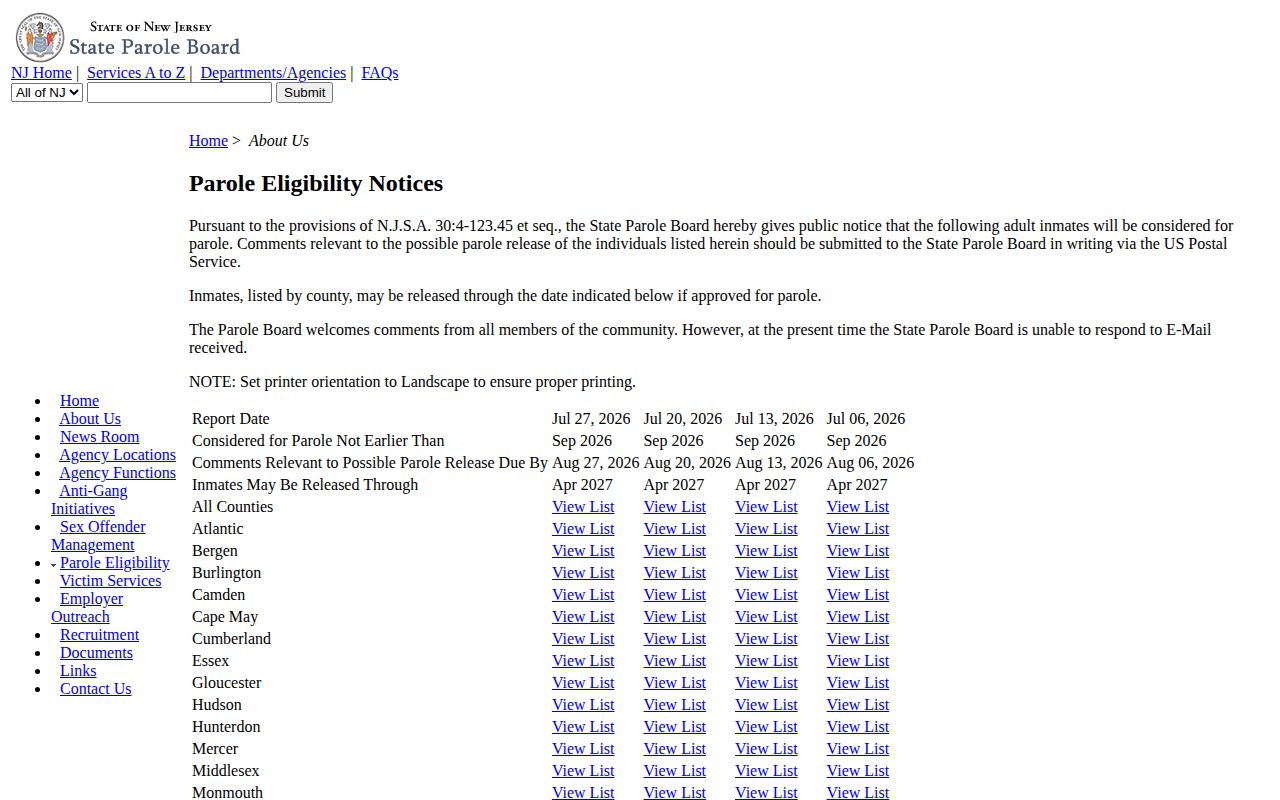
Its dated columns show why a consideration notice must be read as a possible future event, not proof of physical release.
Mercer County Supervision Contacts
Use the office tied to the form of supervision. The State Parole Board can route parole questions and public record requests. The Judiciary’s Probation Ombudsman can explain procedure and identify the proper probation contact, but cannot change a condition, give legal advice, or serve as a personal intermediary.
New Jersey State Parole BoardP.O. Box 862
Trenton, NJ 08625-0862
Public information: SPB-Public-Info-Office@spb.nj.gov
Records: SPB OPRA form New Jersey Judiciary Probation Ombudsman
Phone: 609-815-3810, extension 16357
Email: ProbationHelp.Mailbox@njcourts.gov
Do not ask a public office for a residence, confidential notes, victim data, a risk assessment, or treatment details. A narrow request for an existing release certificate, effective date, discharge date, or public status is easier to route and less likely to seek protected material.
Mercer County Supervision Violations
An alleged violation does not automatically mean that supervision ended. A parolee may remain in the community while a matter is reviewed, may be arrested on a warrant, or may be returned to custody. The Board’s hearing process describes preliminary or probable-cause review and revocation proceedings for serious or persistent alleged parole violations. A panel may revoke parole and set a new future eligibility term, or continue parole with conditions.
“Absconder” generally describes a supervised person alleged to have stopped reporting or left supervision without approval. It does not mean the person is discharged or free of a warrant. SPB accepts parolee or absconder information through its Public Information Office. For probation, the court docket and probation office are the relevant sources. A VINE entry may show a later jail or prison custody event, but VINE is not a public supervision registry.
Quote exact agency terms. “Eligible,” “granted,” “released,” “revoked,” “returned,” and “discharged” describe different stages. Combining old parole text with a newer return-to-custody event can produce a false current status.
Note: A suspected warrant or violation should be confirmed through the responsible court or Board, not inferred from a missing or stale public result.
Mercer County Reentry After Release
Mercer County Correction Center and Mercer County Human Services have coordinated reentry planning through the Returning Citizens Community Program. A published Mercer County grant and program action also documents state funding for a Mercer Re-Entry Program scheduled through June 2027 and continuation of an immediate shelter-bed option through Rescue Mission of Trenton. These programs are release-transition resources. They do not prove that a person is on parole or probation.
Current intake, eligibility, and availability should be confirmed with Mercer County because contracts and funded services can change. Reentry support may begin before release and continue afterward, while supervision remains a separate legal status controlled by SPB or the Judiciary. A service referral should never be treated as a parole condition unless the supervising agency or court record says so.
This local split matters. MCCC may plan a return to the community for a county detainee, but the New Jersey State Parole Board determines state parole status. Human Services can help with transition needs, yet it cannot certify release, amend a court order, or discharge supervision.
Mercer County Property After Release
MCCC’s property pickup instructions tell a civilian collecting inmate property to call 609-583-3545, extension 2262, before arriving. That published procedure does not promise the same steps for the person who was released. Ask MCCC which current process applies to the specific property issue and whether identification or written authorization is required.
Older county medical-service contract specifications documented transition items for a community discharge, including medication, prescriptions, releases of information, notes, and discharge recommendations. Those were contract requirements, not a guarantee of what any one person receives now. Current medical and discharge procedures must be confirmed with the facility, and private medical details are not public supervision records.
Property and transition paperwork may help explain what followed a release. Neither proves that parole or probation is active. Use an SPB discharge or parole record, or the court and probation record, for that legal question.
Mercer County Supervision Discharge
Supervision ends through a documented agency or court event. For parole, request the public discharge date or certificate from SPB when the current NJDOC display does not settle the question. For probation, use the judgment and later court or probation record showing completion, early termination, revocation, or another disposition. A maximum prison date is not automatically the same as parole discharge, especially when a statute imposes a separate supervision term.
New Jersey’s No Early Release Act applies an 85 percent custodial requirement only to specified first- and second-degree violent crimes. It also provides parole supervision terms for covered offenses. The rule is not a formula for every person. Other sentence terms, mandatory minimums, consecutive sentences, credits, Board action, and new court events can affect the timeline.
A person can also finish prison custody while another agency’s hold remains. The final record should identify which status ended and which authority, if any, continued. This keeps a discharge from NJDOC, discharge from parole, and completion of probation from being collapsed into one event.